Showing posts with label bee. Show all posts

Tuesday, November 12, 2013

Feeding Bees In A Top-Bar Hive


We have had bad luck keeping bees these last two seasons. Out of the four colonies we have bought and installed in our hives, we have one colony left. And that colony is not very robust. I believe part of the reason is the bees we buy come from Georgia. Our local bee supplier drives down to Georgia every spring and brings back hundreds of colonies. These bees are acclimated to a southern climate with mild winters. I have yet to get one of these colonies through our more aggressive mid-west winters.

I am planning on trying to capture locally adapted colonies this spring. I have done a lot of research and I feel confident that I can build swarm traps this winter and catch some swarms this spring. I will do a more detailed post on swarm traps and the process of catching swarms after I build the traps.


I have reservations about feeding bees sugar syrup as a general practice. My feeling is if your colony grows accustom to getting some of their food inside the hive they will be less robust foragers and you will breed this trait into them over time. That said, the hive I have left this year has completely eaten through its honey reserves for the winter and if I do not feed them I might as well just empty the hive. I will not buy another colony again. I will try to get this one through the winter, but if they do not make it, they will be the last hive I pay money for.

If you need to feed your hive you can do it very easily. The only equipment you need is a couple mason jars with lids and something to hold them upside down. I bought a couple holders made for this purpose from my local bee supplier, they were cheap and very good at what they do. I took the plastic holders and screwed them to a piece of wood. The mason jar lids need tiny holes in them to let the sugar syrup slowly drip out.

The sugar syrup is pretty simple to make. It is a 2 : 1 ratio of white table sugar to water. This will be thick and will slowly drip out of the holes in the lid when turned upside down. Once the bees find it they will constantly harvest it until it is gone.


The reason I screwed the jar holders to the board is so I could use them in my top-bar hives. The plastic holders are specifically made for Langstroth hives, but with a little modification and they will work in top-bar hives. The bees will find the sugar syrup pretty quickly and start to bring it over to the comb in the hive. I have drilled holes in my follower boards to let the bees come and go through them. However, there is a gap below the follower boards that the bees use instead. That is a design flaw in the way I constructed the follower boards. No big deal in the long run though.


I put one pint of sugar syrup on each side of the main hive. You can't see it in these pictures, but the top-bar next to each of these feeders has a board hanging down similar to the ends of the hive, the follower board. This keeps the center of the hive small making it is easier for the bees to keep themselves warm through the winter. I will have to replace the sugar syrup a couple times throughout the winter if I want the colony to make it. I will only open the hive on the warmest day in the forecast so I do not freeze the bees out. Here is hoping they make it through this winter.


Wednesday, July 25, 2012

Busy Bees


Here is a short video of our bee colony. They have almost filled the hive with honey and brood comb. After they make it through the winter I plan on raising a new queen and splitting the hive in the spring.  


Wednesday, May 23, 2012

Bee Update


So first of all, three days after I put my bees in the hives one colony decided they didn't like my handy work and took off. So I am down to one hive but they are doing very well!


This is the first bar they drew for brood. I find it so amazing how they work so fast, when I sit down in front of the hive I see hundreds of bees go in and out in a few minutes. They are very docile. I have only been stung once and that was because while I was watering my newly sown squash seeds, I must have angered a bee I didn't see, stung me in the neck. 


So this is the other side of the hive. They are up to 6-7 bars now, mostly brood I think. I will start adding on honey bars soon. I will not take any honey this year. If there is enough next spring flow I may take a little. I want to make sure they make it strong through the winter.


This is the sugar / water mixture I am feeding them on the recommendation of the man I bought the bees from. I drilled a whole in the bottom of my follower board to let them access the mixture. I will let them finish this off and I will stop feeding them. Hopefully I will never have to do this again. I will put back honey stores for them in the future in case of an emergency. If all goes well I will split the hive next spring and raise a queen to populate my other hive. 


Sunday, May 13, 2012

Top Bar Bee Hives


So this is how much cedar you need to make two 
top bar hives. Actually I messed up my calculations 
and had to buy a few more boards. =) 


I couldn't find 12 x 1 inch boards so I had to glue 8 x 1 & 4 x 1 
inch boards together to make the sides and ends.


I brought them in over night to dry while clamped.


These are the follower boards. I cut them out of a single board 
I had previously glued together. I used a hand saw because I 
wanted to make sure my cuts were precise. I used a piece
 of wood as a guide so my cuts would be straight. 


Here are the follower boards clamped and glued to a top bar. 
The plans for this hive are free on the internet here. I highly recommend this 
site and the information available on it. 
The forum alone is worth its weight
 in honey.


Here I am screwing the ends to the sides. This is relatively easy 
if you any wood working skills and you follow the suggestion 
of the plan designer by using your follower boards as guides.


My life became much easier once I received my birthday present!
How did she know I wanted this specific portable table saw.
I have a very nice, beautiful and caring fiance who understands 
the value of good machinery at the end of my outstretched arm
 pointing at my soon to be birthday present when 
I drag her to the local box store. =)


The table saw sped up the making of the hives so much. In fact
 I don't think I could have made the top bars the way 
I chose to make them, without it.


To seal the bottom I bought translucent plastic crochet sheets from 
a craft store. You need to make sure whatever you use has small 
enough holes to keep unwanted pests out of your hive. The
 recommendation is something with 8-10 holes to the inch. 


Here are the hives with legs. The front hive has the skeleton of the 
roof, it needs cedar shingles to be complete. The back 
hive has the top bars laying on it after I cut the 
1/8 inch groove in the center of each for wax.  


Here is one of the roofs with the cedar shingles in place. I place
 a plastic sheet over the top of the hive before I put the roof on.
 This water proofs my hive. If you opt to make your roof 
completely water proof you can skip the plastic sheet. 


Here are the top bars. Note the center of each bar has
 a 1/8 inch groove cut out. This will be filled with 
wax so the bees can use it as a comb guide.


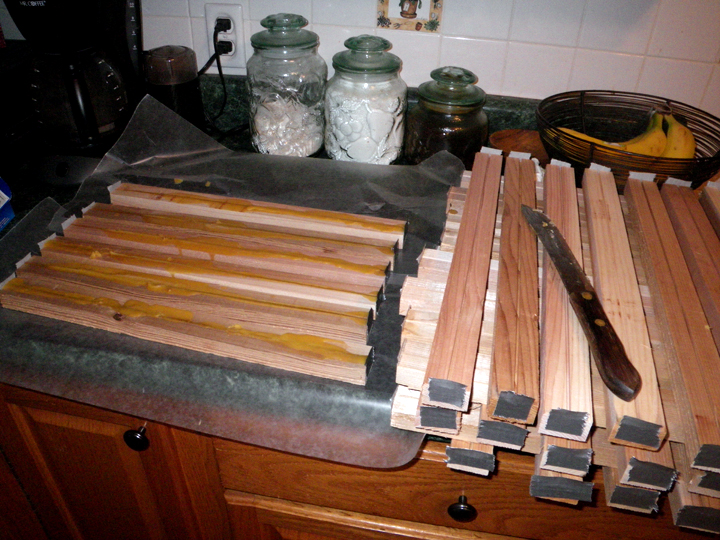
On the left are freshly filled top bars. The bars on the right
 have been cleaned up so only the wax in the center
 is left. Note because I cut the groove straight through 
the top bars some sort of stop needs to be used to
 keep the wax from spilling out of the ends when
 you pour the wax. I opted for duct tape, of course. =)


This is what 10,000 bees look like. The queen is in the 
center in a segregated box so the newly acquainted 
worker and drone bees don't kill her right away.
It is interesting that in a couple days the queen 
bees pheromones will convert the ravenous
 queen-blood thirsty bees into a complacent hive
 ready to defend the her to the death. 


Here I am shaking the bees out of their holding cell 
and into their new home. I did not get stung on 
hiving day, although I had a bee crawl up my 
leg because I forgot to tuck my pants into my socks. 
Luckily it was a drone and couldn't sting me. =)


So here is the finished project. Every piece of wood on the
 hive is cedar even the legs. You could make a hive 
much cheaper than I did, but I personally did not 
want to use pressure treated or chemically
 painted wood for my hives.