Showing posts with label comb guide. Show all posts

Friday, October 18, 2013

We Lost One Of Our Hives.

Homesteading is not easy, nor is it always sunshine and roses like some blogs would have you believe. I feel it is important to share our mistakes and set backs so others can learn from our experiences and realize it is okay to mess up and not get it right the first time or in this case the second. That said I love what we are doing, and can't wait to add more plants and animals to the property.


I realized the traffic in one of our two hives had changed in the amount and nature. I noticed the hive entrance was not being guarded and the amount of bees coming and going had diminished. None of the bees going in the hive had collected pollen and when I looked under the hive I did not see any bees bearding the comb. 


When I opened the hive my suspicions were confirmed. The hive had swarmed. I am not sure if the queen died and they had to raise a new one or they did a split. Whatever happened they had to raise a new queen. Here is what a queen cell looks like. Instead of the uniform hexagons bees normally make, queen cells look more like a mud wasp made them. I found other smaller queen cells around the comb, but I am pretty sure this is the one the new queen emerged from. All the other cells were much smaller than this one, leading me to believe the queen that came out of this cell went around and made sure there were no usurpers in the wings.


This is all that was left in the hive, a handful of dead bees. I have no idea what happened, maybe the hive was stressed and they left after the split. Whatever it was it happened fast. In a normal hive dead bees are cleaned out regularly, so to see so many dead bees left behind makes me scratch my head. All the honey and pollen was completely clean out. I am sure the swarm took most of it and the bees I saw coming and going were robbing what was left. If any bee keepers out there have a theory on what happened please comment down below.


On a happier note, the new comb guides are working much better than the original design I went with. The comb is nice and straight for the most part and no significant cross-combing happened. You can see the comb on the right of this picture was starting to curve a bit into the next bars but that small amount of movement is easy to fix.


You can see the new comb design here. I used cove molding with a 90 degree angle to give the bees a more defined guide. I am not as discouraged as I was last year when this happened. Maybe because I lost both my hives last year. But mainly because of a podcast I heard about capturing local swarms and how easy it is. I plan on making a couple swarm traps to use in the spring. In the meantime I am going to focus my energy on keeping our other hive healthy through the winter. I am going to feed them this year, hoping they will make it through. If not, I will try my best to catch a couple locally adapted swarms in the spring.


Monday, July 8, 2013

Well I'll Bee


 I opened up my hives for the first time since I installed the new colonies. They both are doing great. In my previous post on bees I mentioned one of the hives was lost. After seeing no activity in the hive for days, I saw bees coming and going a week after I thought they were gone.


I don't know if a new swarm came in and set up shop or if the original queen managed to keep the hive going and I just didn't notice it. The hive in question is the one that had the dead queen in it when I installed them.


 You need to make sure your bees have enough room in the hive or they will go into swarm mentality. In a top bar hive set up you have what are called follower boards. These can be moved left and right in the hive to make the center bigger or smaller. When I opened up the hives they were both almost full of comb.


 The new top bar design I am using this year seems to be way better than the old style. The bees are drawing comb on the triangular edging I added to the bars. I did not see any cross combing. I recommend this style of comb guide over the flat bar with a line of wax in a groove.


 Here are some bees on our oregano flowers. I am not sure if these are our bees but the odds are really good.


This is our wormwood. This picture was taken after Dara gave it a pretty good pruning. This perennial is very hardy and does well in our climate. Wormwood is a insect deterrent and can be used to make a tea that is effective against aphids, caterpillars, flea beetles and moths. Don't use wormwood tea on edible plants.


 One of the best flowers you can plant for bees is Borage. Borage is a continuously flowering plant. The flowers are a beautiful blue and are quite delicious in a salad. 


 Borage is an annual but once you plant it it will come back every year from the seeds it drops. It is a good companion plant for tomatoes. The leaves are edible with a cucumber like flavor. They contain a very small amount of alkaloids that can be harmful in large quantities.


I let a lot of alluim (onion, leeks) plants go to flower throughout the garden. Bees absolutely love the flowers, who am I to argue with bees.


Friday, May 17, 2013

I Am Going To Bee So Happy When I Get Some Honey


I decided to try a different top bar design this year. I found that comb would break off of the flat top bars and read that this method is better. I bought some cove moulding to use as a comb guide and some very small nails. 


I had to drill pilot holes to get through the oak moulding. I rubbed some bees wax on the edge of each piece of moulding. 


This is the damage wax moths can do to wood. These are cedar top bars. I was pulling dead larvae out of the holes when I cleaned them up. 


Thousands of bees on the dining room table. The cats kept coming up to the boxes and sniffing, then running away. These bees were packaged and picked up from Georgia by my local bee supplier in the same day.


No matter how ridiculous you look, always tuck your pants into your socks. I have heard first hand accounts of horrible / hilarious stories relating to bee stings and naughty bits. 


This is when I discovered that the queen that came with this hive was dead. Bummer.


Not sure how long she made it but she looked like she had been dead for a while. You see all that white stuff  on the bottom? That is a sugary substance that the colony will eat away to free the queen.


Luckily my bee supplier always gets extra queens. He gave me a marked queen. Can you tell which one is the queen? This queen has been packaged with worker bees to feed her.


After I got back from my emergency trip to the bee suppliers house I forgot to do something very important. Can you see what is wrong with this image? I am not rocking the stylish jeans tucked into socks look that is popular with the youth these days. Luckily I did not have an incident while I dumped the bees into their new home.


Here I am closing up the hive. For all the good that did me. I will elaborate later.


I am installing the sugar water that came with the colony. I have a hole drilled in the separator board so the bees can leave the main hive area and get food while still in the hive. 


Here I am admiring my work. I made a critical mistake though. The hive that had the healthy queen had been together for days and the colony had enough time to accept the queen. The colony I put the new marked queen into did not care for her to much. I did not put a stopper on the entrance and all of the bees left the hive. I checked them this morning and they were all gone. I don't mind making mistakes I just don't like the ones that are $80 a pop. The other hive is doing well. I hope they make it through the winter so I can possibly split the hive next spring to put in my empty hive. 


Sunday, May 13, 2012

Top Bar Bee Hives


So this is how much cedar you need to make two 
top bar hives. Actually I messed up my calculations 
and had to buy a few more boards. =) 


I couldn't find 12 x 1 inch boards so I had to glue 8 x 1 & 4 x 1 
inch boards together to make the sides and ends.


I brought them in over night to dry while clamped.


These are the follower boards. I cut them out of a single board 
I had previously glued together. I used a hand saw because I 
wanted to make sure my cuts were precise. I used a piece
 of wood as a guide so my cuts would be straight. 


Here are the follower boards clamped and glued to a top bar. 
The plans for this hive are free on the internet here. I highly recommend this 
site and the information available on it. 
The forum alone is worth its weight
 in honey.


Here I am screwing the ends to the sides. This is relatively easy 
if you any wood working skills and you follow the suggestion 
of the plan designer by using your follower boards as guides.


My life became much easier once I received my birthday present!
How did she know I wanted this specific portable table saw.
I have a very nice, beautiful and caring fiance who understands 
the value of good machinery at the end of my outstretched arm
 pointing at my soon to be birthday present when 
I drag her to the local box store. =)


The table saw sped up the making of the hives so much. In fact
 I don't think I could have made the top bars the way 
I chose to make them, without it.


To seal the bottom I bought translucent plastic crochet sheets from 
a craft store. You need to make sure whatever you use has small 
enough holes to keep unwanted pests out of your hive. The
 recommendation is something with 8-10 holes to the inch. 


Here are the hives with legs. The front hive has the skeleton of the 
roof, it needs cedar shingles to be complete. The back 
hive has the top bars laying on it after I cut the 
1/8 inch groove in the center of each for wax.  


Here is one of the roofs with the cedar shingles in place. I place
 a plastic sheet over the top of the hive before I put the roof on.
 This water proofs my hive. If you opt to make your roof 
completely water proof you can skip the plastic sheet. 


Here are the top bars. Note the center of each bar has
 a 1/8 inch groove cut out. This will be filled with 
wax so the bees can use it as a comb guide.


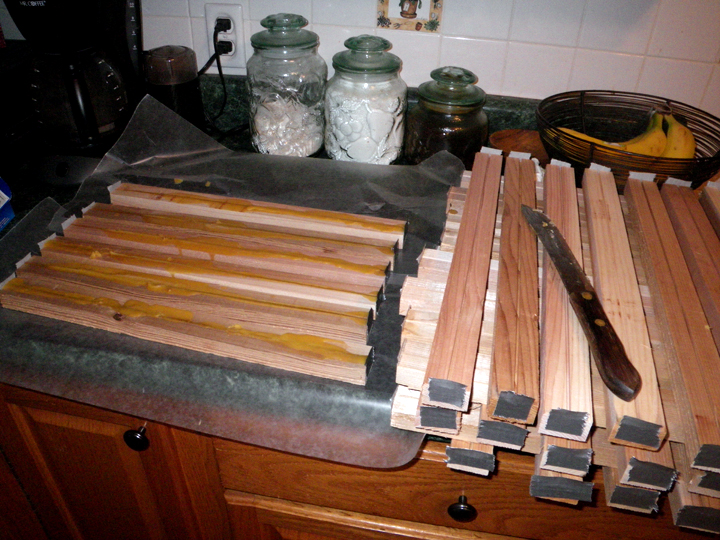
On the left are freshly filled top bars. The bars on the right
 have been cleaned up so only the wax in the center
 is left. Note because I cut the groove straight through 
the top bars some sort of stop needs to be used to
 keep the wax from spilling out of the ends when
 you pour the wax. I opted for duct tape, of course. =)


This is what 10,000 bees look like. The queen is in the 
center in a segregated box so the newly acquainted 
worker and drone bees don't kill her right away.
It is interesting that in a couple days the queen 
bees pheromones will convert the ravenous
 queen-blood thirsty bees into a complacent hive
 ready to defend the her to the death. 


Here I am shaking the bees out of their holding cell 
and into their new home. I did not get stung on 
hiving day, although I had a bee crawl up my 
leg because I forgot to tuck my pants into my socks. 
Luckily it was a drone and couldn't sting me. =)


So here is the finished project. Every piece of wood on the
 hive is cedar even the legs. You could make a hive 
much cheaper than I did, but I personally did not 
want to use pressure treated or chemically
 painted wood for my hives.