Showing posts with label bees. Show all posts

Friday, September 13, 2013

Flowers From Around The Garden


I was walking around the garden yesterday and was surprised by the amount of flowers still in bloom. Having a large variety of plants flowering in your garden is beneficial in many ways. First is beauty, I will step out of my power tool infested man-cave and say, flowers make me happy, plain and simple. Secondly, flowers of different colors, shapes, and sizes bring all kinds of beneficial insects to your garden. Some of these insects are predators that help control insect pests, and some are pollinators that will help pollinate your food crops while they are in the area. Last but not least, many flowers have medicinal properties or are edible, or both. Here are some pics I took yesterday.


This is one of our favorite flowers in the garden. Cosmos (Cosmos bipinnatus) is native to Mexico. The flowers attract birds and butterflies, and bees love them.


We bought a perennial flower seed mix that had dozens of different flowers in it. I am not sure what this is but it is a beautiful flower.


Same thing here, some kind of perennial flower. In the spring I plan on filling the beds along the back of the property with this mix.


Marigolds are very beneficial. They are said to deter some insect pests and bring in beneficial insects. This is a french marigold (Tagetes patula), it is not edible, just beneficial. Some people confuse the inedible french marigold with the edible, sort of look a like, Calendula (Calendula officinalis).


This is Borage (Borago officinalis), which is very edible and delicious. The flowers continuously bloom all through the season. Bees love these flowers and they make a nice addition to a salad.


The first Jerusalem Artichokes (Helianthus tuberosus) are blooming. I took this picture with the camera extended as high as I could above my head and the flower was still a few feet away. Right now these plants are around 10-12 feet tall. I did a detailed post on Jerusalem Artichokes here if you are interested.


Not sure what this plant is. I was about to cut them all down when I noticed it was about to bloom. I am going to leave one and take the rest out. It has a very woody stalk that leads me to believe it might be a perennial. We will see if it comes back in the spring.


This is a perennial I bought in a big box store clearance sale. Not sure what it is, but it comes back every year and the bees like it.


Same here, this is a perennial from a clearance sale. I have a hard time passing up .50 cent flowering perennials.


My addiction strikes again. I often think about getting a part time job at my local big box store just so I can get first dibs on the clearance plants!


Yarrow (Achillea millefolium) is a very valuable plant in the garden. It is a good companion plant, a medicinal and edible. It attracts predatory wasps, ladybugs and hover flies; all very beneficial to have around. It is said to improve the health of sick plants it is near to. Yarrow has been used for centuries as a pain reliever, an astringent, an anti-inflammatory,  a diaphoretic and it was used in ancient times to stanch blood flow in wounds. In those days it was called herbal militaris.


Friday, May 17, 2013

I Am Going To Bee So Happy When I Get Some Honey


I decided to try a different top bar design this year. I found that comb would break off of the flat top bars and read that this method is better. I bought some cove moulding to use as a comb guide and some very small nails. 


I had to drill pilot holes to get through the oak moulding. I rubbed some bees wax on the edge of each piece of moulding. 


This is the damage wax moths can do to wood. These are cedar top bars. I was pulling dead larvae out of the holes when I cleaned them up. 


Thousands of bees on the dining room table. The cats kept coming up to the boxes and sniffing, then running away. These bees were packaged and picked up from Georgia by my local bee supplier in the same day.


No matter how ridiculous you look, always tuck your pants into your socks. I have heard first hand accounts of horrible / hilarious stories relating to bee stings and naughty bits. 


This is when I discovered that the queen that came with this hive was dead. Bummer.


Not sure how long she made it but she looked like she had been dead for a while. You see all that white stuff  on the bottom? That is a sugary substance that the colony will eat away to free the queen.


Luckily my bee supplier always gets extra queens. He gave me a marked queen. Can you tell which one is the queen? This queen has been packaged with worker bees to feed her.


After I got back from my emergency trip to the bee suppliers house I forgot to do something very important. Can you see what is wrong with this image? I am not rocking the stylish jeans tucked into socks look that is popular with the youth these days. Luckily I did not have an incident while I dumped the bees into their new home.


Here I am closing up the hive. For all the good that did me. I will elaborate later.


I am installing the sugar water that came with the colony. I have a hole drilled in the separator board so the bees can leave the main hive area and get food while still in the hive. 


Here I am admiring my work. I made a critical mistake though. The hive that had the healthy queen had been together for days and the colony had enough time to accept the queen. The colony I put the new marked queen into did not care for her to much. I did not put a stopper on the entrance and all of the bees left the hive. I checked them this morning and they were all gone. I don't mind making mistakes I just don't like the ones that are $80 a pop. The other hive is doing well. I hope they make it through the winter so I can possibly split the hive next spring to put in my empty hive. 


Tuesday, August 7, 2012

One of ours?


Not really sure if this is one of our bees, but every time I see a honey bee in the garden I like to think so. Bees absolutely love onion flowers. If you ever see your onions going to flower let them go and enjoy all the beneficial insects they bring in. 


The bees are really filling up the hive. I can't wait till spring to try some of that honey!

Wednesday, May 23, 2012

Bee Update


So first of all, three days after I put my bees in the hives one colony decided they didn't like my handy work and took off. So I am down to one hive but they are doing very well!


This is the first bar they drew for brood. I find it so amazing how they work so fast, when I sit down in front of the hive I see hundreds of bees go in and out in a few minutes. They are very docile. I have only been stung once and that was because while I was watering my newly sown squash seeds, I must have angered a bee I didn't see, stung me in the neck. 


So this is the other side of the hive. They are up to 6-7 bars now, mostly brood I think. I will start adding on honey bars soon. I will not take any honey this year. If there is enough next spring flow I may take a little. I want to make sure they make it strong through the winter.


This is the sugar / water mixture I am feeding them on the recommendation of the man I bought the bees from. I drilled a whole in the bottom of my follower board to let them access the mixture. I will let them finish this off and I will stop feeding them. Hopefully I will never have to do this again. I will put back honey stores for them in the future in case of an emergency. If all goes well I will split the hive next spring and raise a queen to populate my other hive. 


Sunday, May 13, 2012

Top Bar Bee Hives


So this is how much cedar you need to make two 
top bar hives. Actually I messed up my calculations 
and had to buy a few more boards. =) 


I couldn't find 12 x 1 inch boards so I had to glue 8 x 1 & 4 x 1 
inch boards together to make the sides and ends.


I brought them in over night to dry while clamped.


These are the follower boards. I cut them out of a single board 
I had previously glued together. I used a hand saw because I 
wanted to make sure my cuts were precise. I used a piece
 of wood as a guide so my cuts would be straight. 


Here are the follower boards clamped and glued to a top bar. 
The plans for this hive are free on the internet here. I highly recommend this 
site and the information available on it. 
The forum alone is worth its weight
 in honey.


Here I am screwing the ends to the sides. This is relatively easy 
if you any wood working skills and you follow the suggestion 
of the plan designer by using your follower boards as guides.


My life became much easier once I received my birthday present!
How did she know I wanted this specific portable table saw.
I have a very nice, beautiful and caring fiance who understands 
the value of good machinery at the end of my outstretched arm
 pointing at my soon to be birthday present when 
I drag her to the local box store. =)


The table saw sped up the making of the hives so much. In fact
 I don't think I could have made the top bars the way 
I chose to make them, without it.


To seal the bottom I bought translucent plastic crochet sheets from 
a craft store. You need to make sure whatever you use has small 
enough holes to keep unwanted pests out of your hive. The
 recommendation is something with 8-10 holes to the inch. 


Here are the hives with legs. The front hive has the skeleton of the 
roof, it needs cedar shingles to be complete. The back 
hive has the top bars laying on it after I cut the 
1/8 inch groove in the center of each for wax.  


Here is one of the roofs with the cedar shingles in place. I place
 a plastic sheet over the top of the hive before I put the roof on.
 This water proofs my hive. If you opt to make your roof 
completely water proof you can skip the plastic sheet. 


Here are the top bars. Note the center of each bar has
 a 1/8 inch groove cut out. This will be filled with 
wax so the bees can use it as a comb guide.


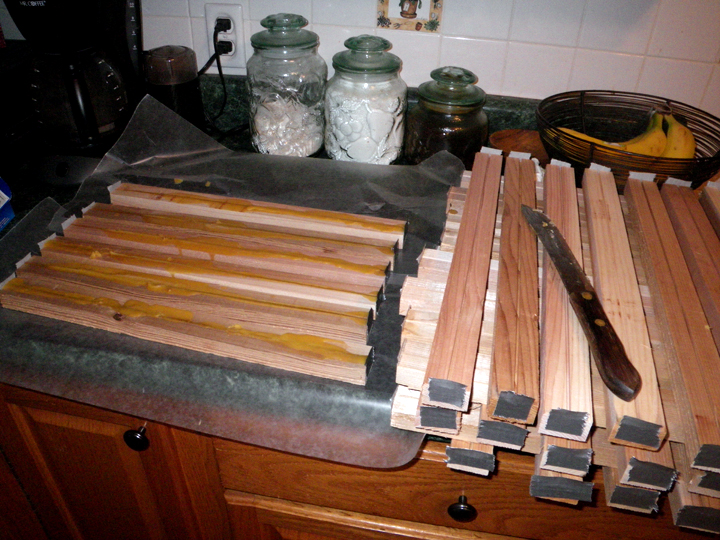
On the left are freshly filled top bars. The bars on the right
 have been cleaned up so only the wax in the center
 is left. Note because I cut the groove straight through 
the top bars some sort of stop needs to be used to
 keep the wax from spilling out of the ends when
 you pour the wax. I opted for duct tape, of course. =)


This is what 10,000 bees look like. The queen is in the 
center in a segregated box so the newly acquainted 
worker and drone bees don't kill her right away.
It is interesting that in a couple days the queen 
bees pheromones will convert the ravenous
 queen-blood thirsty bees into a complacent hive
 ready to defend the her to the death. 


Here I am shaking the bees out of their holding cell 
and into their new home. I did not get stung on 
hiving day, although I had a bee crawl up my 
leg because I forgot to tuck my pants into my socks. 
Luckily it was a drone and couldn't sting me. =)


So here is the finished project. Every piece of wood on the
 hive is cedar even the legs. You could make a hive 
much cheaper than I did, but I personally did not 
want to use pressure treated or chemically
 painted wood for my hives.