Showing posts with label hive. Show all posts

Monday, November 26, 2012

Hive Disaster

The last time I opened up my hive I noticed the honey stores would not get them through the winter. So this past weekend I decided to open the hive and put some supplemental feed in for the winter. I had not checked my hive for a while other than watching bees come and go. 

I did not realize the bees coming and going recently, were not mine. They were robbing the abandoned hive. I guess I should have fed them earlier, maybe they would have had a better shot at surviving the first year. I hope I have better luck next year. 

The abandoned hive was not my only surprise.  As I started pulling top bars I noticed what I thought was a lot of spider webs. Boy was I wrong.


These are the larva of Achroia grisella or the Lesser Wax Moth. These are very plump from eating my hives wax and pollen stores. Waxmoths are bred and sold at pet shops as feeder worms. 


This is the damage they can do to a hive. This was my brood comb.


The wax gets completely destroyed. Almost all of my comb looks like this.


Almost all of the honey stores are gone. I am not sure if this is because the bees left with it, it got robbed or the wax moth larvae ate it. 


Here is a pic of some cross combing on the end of the hive. I wish this was my only problem.


Here is a pic of the little bastards. I plan on building new top bars for the hives. Hopefully next year I can get both hives healthy and able to fight this kind of infestation off. 


Here is the only honey I found in the hive. It tastes amazing. Hopefully I will have a better harvest next time. All I can do now is learn from my experience and do better next time. 


Thursday, September 6, 2012

Not everything is a success

I thought I would share a couple homestead fails we have had recently. I try to look at these events as learning experiences. "Try" is the key word here. 


If you are new to bee keeping this may not look like a bad picture. Plenty of healthy looking bees building comb and using propolis to seal up the hive. The problem is the comb is going perpendicular to the top bars. This is called cross-combing and is bad for a hive if you want to manage it properly. I should have checked the hive earlier and corrected it sooner. At this point my plan is to wait until spring and harvest this quarter of the hive for honey and watch them more carefully when they are drawing comb. 


This is whats left of the pole beans I planted a while back. I posted earlier on an assassin bug I found in the garden eating a bean leaf beetle (Cerotoma trifurcata). Well I guess I needed an army of assassin bugs to deal with the amount of bean leaf beetles that came this year. They ate every single plant that sprouted, but they did not touch the established pole beans growing 15 feet away. Maybe they just like new growth. I planted the beans late, hoping to get a second crop this year, so maybe I need to start them earlier next year. I will use this area to plant winter snap peas soon.

Tuesday, August 7, 2012

One of ours?


Not really sure if this is one of our bees, but every time I see a honey bee in the garden I like to think so. Bees absolutely love onion flowers. If you ever see your onions going to flower let them go and enjoy all the beneficial insects they bring in. 


The bees are really filling up the hive. I can't wait till spring to try some of that honey!

Wednesday, May 23, 2012

Bee Update


So first of all, three days after I put my bees in the hives one colony decided they didn't like my handy work and took off. So I am down to one hive but they are doing very well!


This is the first bar they drew for brood. I find it so amazing how they work so fast, when I sit down in front of the hive I see hundreds of bees go in and out in a few minutes. They are very docile. I have only been stung once and that was because while I was watering my newly sown squash seeds, I must have angered a bee I didn't see, stung me in the neck. 


So this is the other side of the hive. They are up to 6-7 bars now, mostly brood I think. I will start adding on honey bars soon. I will not take any honey this year. If there is enough next spring flow I may take a little. I want to make sure they make it strong through the winter.


This is the sugar / water mixture I am feeding them on the recommendation of the man I bought the bees from. I drilled a whole in the bottom of my follower board to let them access the mixture. I will let them finish this off and I will stop feeding them. Hopefully I will never have to do this again. I will put back honey stores for them in the future in case of an emergency. If all goes well I will split the hive next spring and raise a queen to populate my other hive. 


Sunday, May 13, 2012

Top Bar Bee Hives


So this is how much cedar you need to make two 
top bar hives. Actually I messed up my calculations 
and had to buy a few more boards. =) 


I couldn't find 12 x 1 inch boards so I had to glue 8 x 1 & 4 x 1 
inch boards together to make the sides and ends.


I brought them in over night to dry while clamped.


These are the follower boards. I cut them out of a single board 
I had previously glued together. I used a hand saw because I 
wanted to make sure my cuts were precise. I used a piece
 of wood as a guide so my cuts would be straight. 


Here are the follower boards clamped and glued to a top bar. 
The plans for this hive are free on the internet here. I highly recommend this 
site and the information available on it. 
The forum alone is worth its weight
 in honey.


Here I am screwing the ends to the sides. This is relatively easy 
if you any wood working skills and you follow the suggestion 
of the plan designer by using your follower boards as guides.


My life became much easier once I received my birthday present!
How did she know I wanted this specific portable table saw.
I have a very nice, beautiful and caring fiance who understands 
the value of good machinery at the end of my outstretched arm
 pointing at my soon to be birthday present when 
I drag her to the local box store. =)


The table saw sped up the making of the hives so much. In fact
 I don't think I could have made the top bars the way 
I chose to make them, without it.


To seal the bottom I bought translucent plastic crochet sheets from 
a craft store. You need to make sure whatever you use has small 
enough holes to keep unwanted pests out of your hive. The
 recommendation is something with 8-10 holes to the inch. 


Here are the hives with legs. The front hive has the skeleton of the 
roof, it needs cedar shingles to be complete. The back 
hive has the top bars laying on it after I cut the 
1/8 inch groove in the center of each for wax.  


Here is one of the roofs with the cedar shingles in place. I place
 a plastic sheet over the top of the hive before I put the roof on.
 This water proofs my hive. If you opt to make your roof 
completely water proof you can skip the plastic sheet. 


Here are the top bars. Note the center of each bar has
 a 1/8 inch groove cut out. This will be filled with 
wax so the bees can use it as a comb guide.


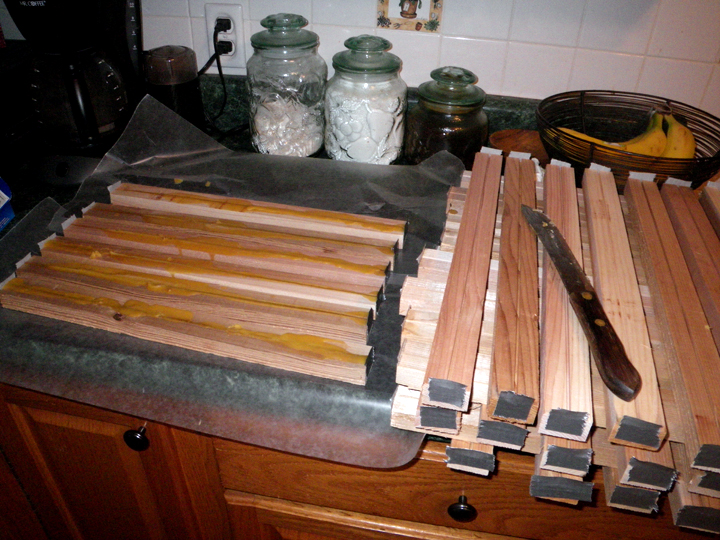
On the left are freshly filled top bars. The bars on the right
 have been cleaned up so only the wax in the center
 is left. Note because I cut the groove straight through 
the top bars some sort of stop needs to be used to
 keep the wax from spilling out of the ends when
 you pour the wax. I opted for duct tape, of course. =)


This is what 10,000 bees look like. The queen is in the 
center in a segregated box so the newly acquainted 
worker and drone bees don't kill her right away.
It is interesting that in a couple days the queen 
bees pheromones will convert the ravenous
 queen-blood thirsty bees into a complacent hive
 ready to defend the her to the death. 


Here I am shaking the bees out of their holding cell 
and into their new home. I did not get stung on 
hiving day, although I had a bee crawl up my 
leg because I forgot to tuck my pants into my socks. 
Luckily it was a drone and couldn't sting me. =)


So here is the finished project. Every piece of wood on the
 hive is cedar even the legs. You could make a hive 
much cheaper than I did, but I personally did not 
want to use pressure treated or chemically
 painted wood for my hives.