Sunday, February 5, 2012

Starting seeds indoors with soil cubes


 This is the Soil Cube Tool, designed and sold by 
Clayton Jacobs. ( www.soilcube.com )  
This is a pretty simple design that is practical and
 easy to use. Basically inside the white squares are 
metal plates attached to the bolts. When you push
 down on the handle the plates compress the soil
 medium into cubes and leave a divot for seed
placement. The springs push the handle
 back to the starting position. 


These are the components of the soil medium. The ratio is:
          3 parts peat moss
       2 parts compost
          1 part garden soil
1 part sand 
  1 part perlite
           Add lime if desired
You can also add fertilizer at this point if you wish. 
I would personally use worm castings and some compost tea. 
You can tweak this mixture for making soil cubes 
but I would stick to the ratios and use medium
 similar to the products in the picture. 


I mixed everything together dry in this large "hose" bucket. 
You can get these at your local box store for $4. I then split 
the mix into three buckets so I could make sure it gets mixed 
consistently. Add just enough water to get a thick oatmeal 
consistency. Once the first 1/3 is mixed add more dry soil 
mixture and repeat. I make a lot of this once a year, saves
 time and it doesn't hurt to have extra.


 Press the tool into the mix and press it against the 
side just filling the inside of the tool with the soil mixture. 
Press down on a hard surface, hold for a second then push 
the handle through the tool and the cubes will fall out. 
It takes a bit of practice to get consistent cubes but if you
 mess up just crumble the bad cube back into the mix.


Here is a close up of the cubes when they are done. 
They hold together very well and readily absorb water. 


Here are the same cubes growing tomatos. 
We have 188 cubes started right now. We are growing
 8 types of tomatos, 7 types of peppers, eggplant,
 celery, leeks, 3 types of onions, broccoli, cauliflower, 
brussel sprouts, green cabbage, red cabbage and kohlrabi. 


Place the cubes in a tub like this, it is very 
easy to move them without handeling them. 
You can pour water in the bottom of the tub which 
the cubes will soak up and wick through the cube. 
Don't let them sit in a pool of water, 
use just enough to saturate the cubes.


This is many varieties of lettuce, spinach, cilantro and amaranth. 
They are growing in trays filled with the grow medium. 
You can grow salad greens all year round without 
them bolting or going bitter in the heat.


Here is the whole set up. The lights are full spectrum
 4 foot fluorescents hanging on chains from a stainless
 steel shelving unit. The lights are on a timer set to come
 on at 5am and go off at 9pm. I have heating pads under
 the peppers and tomatos to help them germinate. I use a 
one gallon hand pump pressure sprayer to mist the cubes 
gently so the seeds are not disturbed. 

Sunday, January 29, 2012

Installing Hard Wood Floors = Self-Flagellation


 Good bye carpet. Hello weeks of second thoughts and sore knees.


Each one of these bundles is 20 square feet of "rustic" 
solid oak tongue and groove flooring. A total of 240 square feet. 
We ended up buying 60 square more to finish the project. 
About 25 percent of the boards were "junk" and could not be used. 
Remember, if you decide to put your own wood floor in, 
it's very important to let the wood sit in the room it will be 
installed in for at least a week. The wood needs to acclimate
 to its new environment before you nail it down.


We started against the wall where the majority of foot traffic will be so the
 floor would appear to be straight for the main walkway. I had to pour a
 leveling cement on the floor to raise it 1/8 of an inch before we laid the 
red "rosin" paper against the wall. The stacks on the left are ordered 
by the quality of the boards. The farthest stacks are the best boards 
which we used in the walkway and other highly visible areas, 
while the imperfect boards are used against the wall
 and other out of the way places.


Here is Dara fitting the boards in a row so as not to have any of the
 seams next to each other. You should have at least 3-4 inches in
 between the end of the board and the end of the board in the 
previous row. This can be a frustrating process but necessary 
so you have a tight, unmoving floor. 


This device is a manual nail-gun. This throws a 2 inch tapered nail 
at an angle through the tongue and into the floor when you smash the
 piston down with the rubber mallet. If you don't hit the piston just right
 the nail doesn't go in fully and needs to be pulled.


This is the last nail in the last row! I estimate I used at least 4,500 nails
 putting the floor in. It was very satisfying pounding this nail in.


I rented a belt sander to sand the majority of the room. I rented an 
edge sander for the spots the belt sander couldn't reach. All the spots
 in the image are dust particles that I am sure are still in my lungs. 
Wear a mask when you do this!


 Here is the stain we chose. I ended up putting two coats down. Once that
 dried I put down a polyurethane coat to seal the floor. 


And this is the finished project! Maybe in five years or so when my knees
 and back forget about this, I may consider doing another room.

P.S. If you really want to test your relationship install a hardwood
 floor together. If you make it through it, you were meant to be.


Wednesday, January 11, 2012

And... we're back!

Right so, now that we're all caught up on the last three seasons of Dexter we thought we ought to start posting again. Quick post though, we need to plant seeds tonight!! Amazing how fast things roll around.

Anyway, we started this Paleo thing. Awesome! I feel great. Never, ever eating wheat again. But supplements are recommended so I went to get a couple things from the vitamin store like fish oil, vit D, common things we don't get enough of. Well I also needed probiotics. The girl working, who was helpful about most everything, confused the hell out of me about the probiotics. They need to be live not freeze dried, well even the refrigerated kind are dried, and the liquid kind, these are more but they help you culture your own unique bacteria (am I not doing that already?). So I said to hell with this, I'm just going to ferment cabbage and make my own bacteria. Everyone should do this. It tastes good and it's good for you.

I put 2 TBS of sea salt (MUST be sea salt) and a cup of filtered water into a mason jar. You'll need to stir it until the salt has disolved completely and then add shredded cabbage (or whatever other veggie). I also added a celery stalk to mine. It works as a preservative, totally optional. Fill the mason jar up to the top with filtered water. Place it on a saucer to catch the overflow and stick a slightly tapered glass in the top. This allows air to touch the water but not the veggies. Don't let the veggies touch the air... at least not for very long. As the water evaporates (or as you eat cabbage) just pull the glass out and add more water. I liked it best after 3 days but we're still eating it after a couple weeks. YUM!


Sunday, November 20, 2011

Paleo Almond Joy Smoothie

Ok, so this is supposed to have a picture but seriously I always think about blogging this after I've drank the entire thing. So if you want to see what it looks like I guess you'll have to make it.

1 frozen banana
2ish Tbsp of almond butter (the real stuff, no sugar)
tons of cocoa powder (I read somewhere it prevents stroke so uh.. the more the better, right?)
1/3 can coconut milk (the real stuff, none of that crap in a box. get it in the can with lots of fat)
optional: whey protein powder
almond milk to desired consistency (ok, I get mine in a box, it's all I can find. it's processed,
totally a "cheat" so if you were hardcore I guess you could just use water or more coconut)

Blend together and put in a chilled glass. Yum! And if you're like me you'll also have a cup of coffee.

Thanks for the Ninja, Uncle Jim!

Sunday, November 13, 2011

The harvest recap

Hi everyone!!! So much has happened we haven't been able to post in a while. First of all,
as most everyone knows now, we are engaged (post to come on the ring)!! Yay! Second,
we have been installing our own wood floor (post to come) which is taking quite a long
time. Third, Patrick is officially a volunteer fireman, w00t! And lastly— whew—we are now
on the Paleo diet which means learning to cook lots of interesting meals (hopefully
some posts to come on that as well).

So on to the post. I realize we showed lots of pics of the garden and the work but not a lot of what we got out of it. So here's a few harvest pics from July to now and the unveiling of the potato box.


Sorry for the poor picture. Going clockwise from the bottom that's
Kale, Swiss Chard, Amaranth and Lambs Quarter. There was
enough Amaranth and Lambs Quarter to make 2 weeks worth of
dinners but we wasted most of it... you get tired of eating the same
thing (plus the Amaranth was slightly bitter) but at least we know
we COULD go that long without buying food.


Best watermelon I've ever eaten.


Dragon carrots. Still have some of these in the garden.


This was a good week. We still have lots of leeks in the yard
and we just finished off what peppers we had harvested. There
were a few bags full of them. Wasn't that interested in the ground
cherries. Need to figure out what to do with them next year.
Let me know if you have a suggestion!


The Potato Box!!! We ran out of straw early though and didn't
get more. You can see it looks low.


This looks promising though...


Wha...?


FAIL


Me thinks this is a seed potato.

You don't eat potatoes on
Paleo anyway... sometimes things just work out.


Friday, September 16, 2011

All Grain Brewing


I have officially upgraded my brewery. That black burner puts out over 210,000 BTU's! A small upgrade from the old gas stove...


So here is the new set up. My three tier system now consist of ladders, saw horses and the ground. 180 degree water flows out of the bucket on the top level to the mash tun (pictured below full of grains) then the wort (sugar water) flows out of the mash tun into a collection pot (two pictures down).  


The 180 degree water goes into this apparatus called a sparge arm. It sprinkles the water into the mash tun so it does not disturb the grain bed.  


When the water makes it all the way through the mash tun it flows into this collection pot. This process is called the "sparge". During the sparge you slowly let the wort out of the mash tun until you get a clear stream without debris. 


You then put all the wort into this large aluminum brew kettle. We usually get about 6 1/2 - 7 gallons of wort. 


This is Master Brewer and friend Nissen checking the specific gravity of the wort before the boil. In this application specific gravity is a measure of sugar suspended in solution. 


Now its time to put this awesome burner to the test. It use to take us over an hour to bring the wort to boil. With the new burner I believe we had a rolling boil in 25 minutes!


It is very important to cool the wort down to around 75 degrees from boiling as fast as you can. Those two copper tubes sticking out of the kettle are part of a heat exchanger called a wort chiller. It is pictured in the second image. Cold water goes in from a hose and hot water flows out into the bucket next to the kettle.


Once the wort is cooled down it is "racked" (transfered) to a "carboy" (large glass fermentation vessel) using an auto-siphon. After the carboy is filled you need to aerate the wort. We use a large plastic spoon handle to mix air into the wort. Once it is properly aerated we inoculate the wort with our yeast culture and put an airlock on the carboy. It is then stored in a cool dark place for three weeks. I racked this particular beer straight into a keg and was drinking it before it was a month old!   

Saturday, September 3, 2011

Squash vine borers!


Two months ago was the first time I had ever heard of anything called
a squash vine borer, so when I walked outside one afternoon to see
these drooping leaves I had no idea what could possibly be going on.
It took about an hour for me to figure it out, though the signs were more
than obvious. 5 plants had been invaded. The vines looked corroded and
had the "sawdust" appearance. The worms had burrowed a foot and a
half into our largest squash vine, splitting it open at the base.

My understanding is that not much can be done if you are an organic gardener.
So the first thing I did was plant 6 new squash plants elsewhere in the yard.
Then I defiantly set to work trying to help the infected plants. I slit the plants
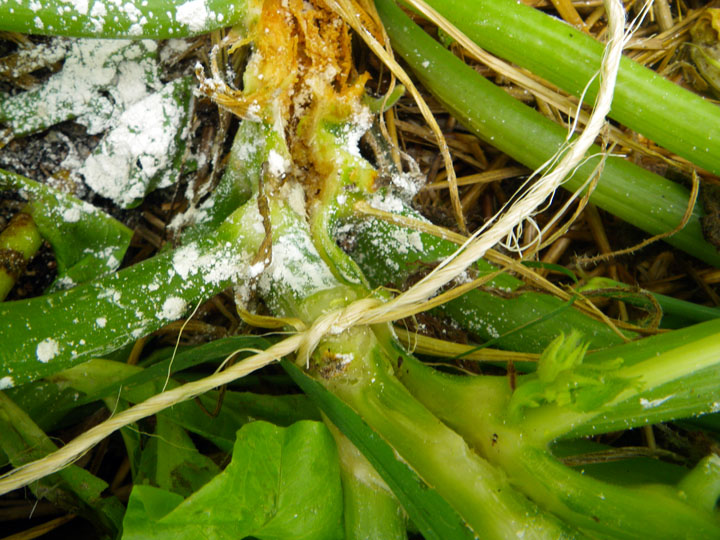
open with a razor from the base up to where the plant was nice and healthy.

And that's where I found these guys. Now I knew without a doubt we had
borers!! Sorry there's no picture of them in the plant. I was so angry I just
flipped them out before I thought to take one. Then I smashed them.

I tied the vine back together where I cut it open because that
seemed like the thing to do. I read that you need to get the plant
to root above the damage and so I thought it would help if I could
keep the damaged part functional long enough for the rooting to
take place. After I tied it up I buried the section above in soil.


The last thing I did was sprinkle diatomaceous earth on the damaged
parts. I saw smaller brown larve looking things in the vine and I
didn't want to take any chances. I have never heard of putting DE in a
plant but we've had no problems. In fact, it's been 2 weeks since
this all happened and there's new growth on this squash plant. It
has also maintained fruit production. So far we haven't lost any plants.